
CO₂ MANAGEMENT FOR COMPANIES AND PRODUCTS
natureOffice combines CO₂ software, personal support and traceable climate contributions. Turning individual requirements into a reliable process.
Since 2008 in CO₂ management · Software and personal support
WHY NATUREOFFICE?
It's not the first number that is the problem. But everything that comes after it.
And by the time of the next data update at the latest, the search through tables, emails and old assumptions starts all over again. That is why we do not view CO₂ management as a one-off calculation.
TWO TASKS. ONE COMMON STANDARD.
Understand what is emerging. Decide what follows.
UNDERSTAND AND PROCESS CO₂ FURTHER
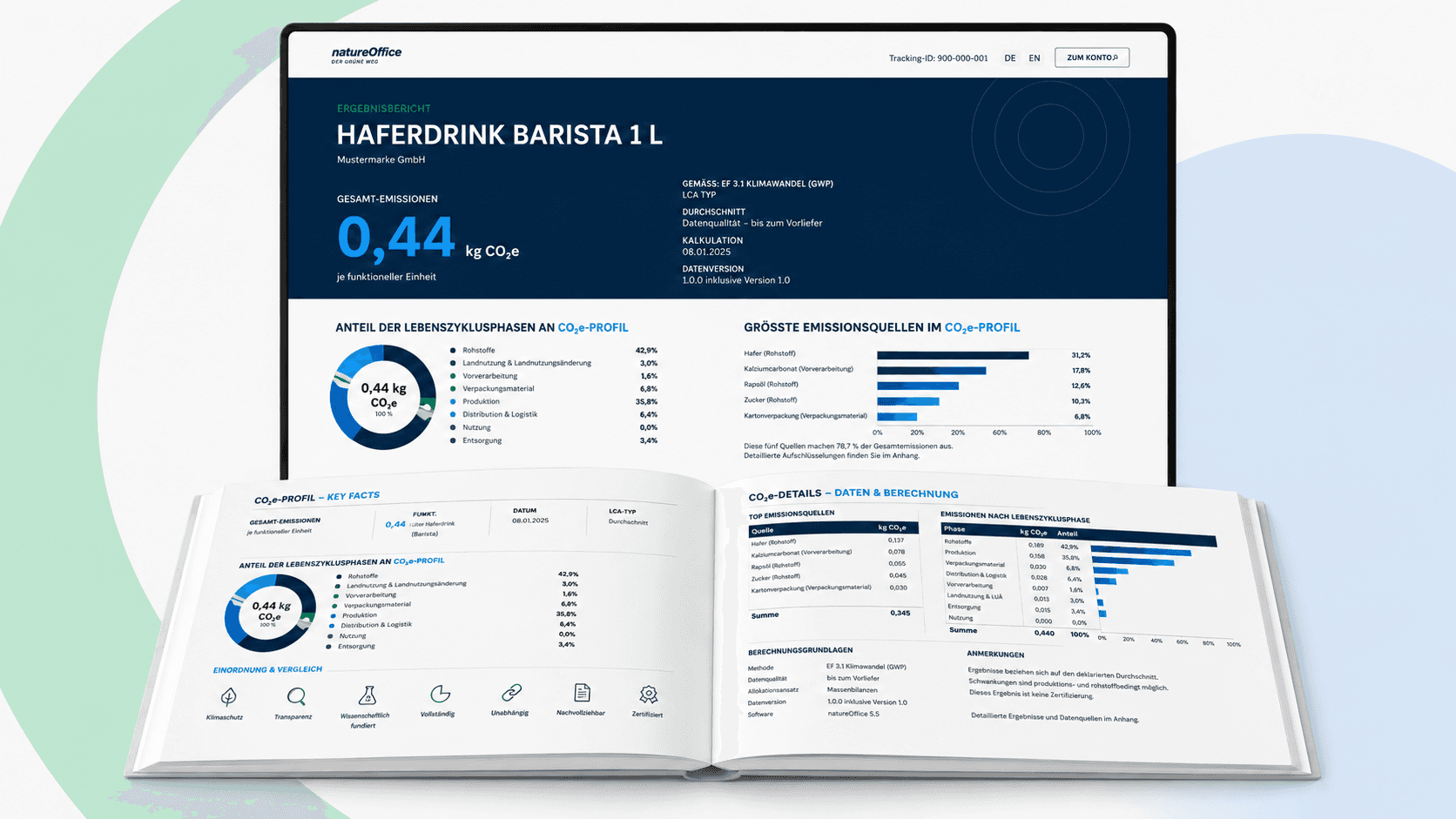
With ecozoom, you bring data, calculations, and their foundations together in one place. This allows CCFs and PCFs to be continuously updated – instead of starting from scratch with every request.
CCF
PCF
Tracking
Discover CO₂ software

CO₂ SOFTWARE BY NATUREOFFICE
01
Where do our company's emissions come from? A CCF creates clarity – for reports, priorities and further reduction planning.
Get to know CCF
02
Which emissions belong to the product? A PCF provides clarity – for customers, supply chains, tenders, and product variants.
Get to know PCF
03
Calculation logic, data sources, assumptions, and versions remain documented. New data states build upon an existing structure.
All software paths

MAKING CO₂ DATA EXPLAINABLE
Key factsheets and digital tracking pages make the system boundary, reference period, data status, sources and assumptions accessible to customers, suppliers or internal teams.
CO₂ DATA AVAILABLE
The label is not a seal, an award, or a statement about whether a company or product is 'climate-friendly'. It shows that CO₂ data is available – and where to find the basis for it.
Provide traceable CO₂ data

SOFTWARE AND PEOPLE
Software creates structure. Experience decides which structure suits you.
No company produces in the same way. No product has the same materials, processes and supply routes. That is why our work does not begin with a blank login, but with your actual usecase.
01
Orientation
Clarifying requirements, risks and a sensible starting point.
02
Setup
Map products, locations and data paths to match your processes.
03
Further work
Update with new data and variants based on the existing foundation.

CONTINUE WORKING WITH THE DATA
CCF and PCF make emission sources visible. Based on this, you can prioritise measures, develop target pathways, and reassess progress with updated data.
SBTi supports science-based target pathways. VSME, ESRS or EcoVadis perform a different task: they structure reporting disclosures or assess sustainability management. They replace neither the greenhouse gas inventory nor the actual reduction measure.
Thinking beyond CO₂ reduction
01
Balance sheet
Initial situation
02
Hotspots
Priorities
03
Measures
Change
04
New data status
Progress

CLIMATE PROTECTION BEYOND ONE'S OWN BALANCE SHEET
Measuring and reducing one's own emissions remains central. At the same time, many climate and development measures require additional funding. Companies can continue to support such initiatives – without deriving a climate neutrality claim from doing so.
Route 1
For companies that rely on recognised project standards, verified CO₂e units and documented decommissioning.
The unit proves the project-related process – it does not automatically make companies or products climate-neutral.
Portfolio and Standards
Route 2
For specific ecological or social activities, the purpose and implementation of which are documentably trackable.
Since there is no claim of offsetting against one's own emissions, not every meaningful commitment needs to be defined via a CO₂ certificate.
Understanding direct contributions
The contribution remains. The offsetting disappears.
CCF and PCF remain unchanged. The project that was supported and what the contribution enables are documented.
OUR OWN PROJECT
PROJECT TOGO combines reforestation and biodiversity with access to water, education, employment and local value chains. Companies support clearly defined measures and gain insight into their implementation.

WHAT WE CONNECT
01
Software and Methodology
Data is documented within its professional context.
02
Standard and Reality
Specifications are transferred to real products, locations and processes.
03
Calculation and distribution
Results remain usable and explainable with their underlying basis.
04
Balance sheet and additional commitment
Reductions and climate contributions remain clearly separated.
WHERE TO BEGIN?
You do not have to start with everything. Just with the right first step.

BRIEFLY EXPLAINED
Questions that almost always arise at the beginning.
Do we need a CCF or a PCF?
A CCF considers the emissions of a company or an organisational unit. A PCF refers to a clearly defined product and a functional unit. If both questions are relevant, the data paths can be aligned with one another.
Do our data need to be complete before the start?
No. At the beginning, it is more important to clarify the goal, the balance sheet object and the system boundary. After that, it becomes clear which data is available, where assumptions are necessary and which gaps can be closed step by step.
Is 'CO₂ DATA AVAILABLE' a seal?
No. The notice is not an award, certification, or environmental assessment. It leads to the available CO₂ data and its documented basis.
Does a climate contribution change our CCF or PCF?
No. A climate contribution is presented separately from one's own balance sheet. It does not reduce the calculated value and does not justify climate neutrality of the company or product.
Do climate projects always have to be CO₂ certified?
Not every direct project support requires a CO₂ certificate. The key factor is the associated claim. The purpose, scope, timeframe and implementation should be documented in a transparent manner – without using this to claim offsetting of your own emissions.
LET'S TALK ABOUT YOUR STARTING POINT